

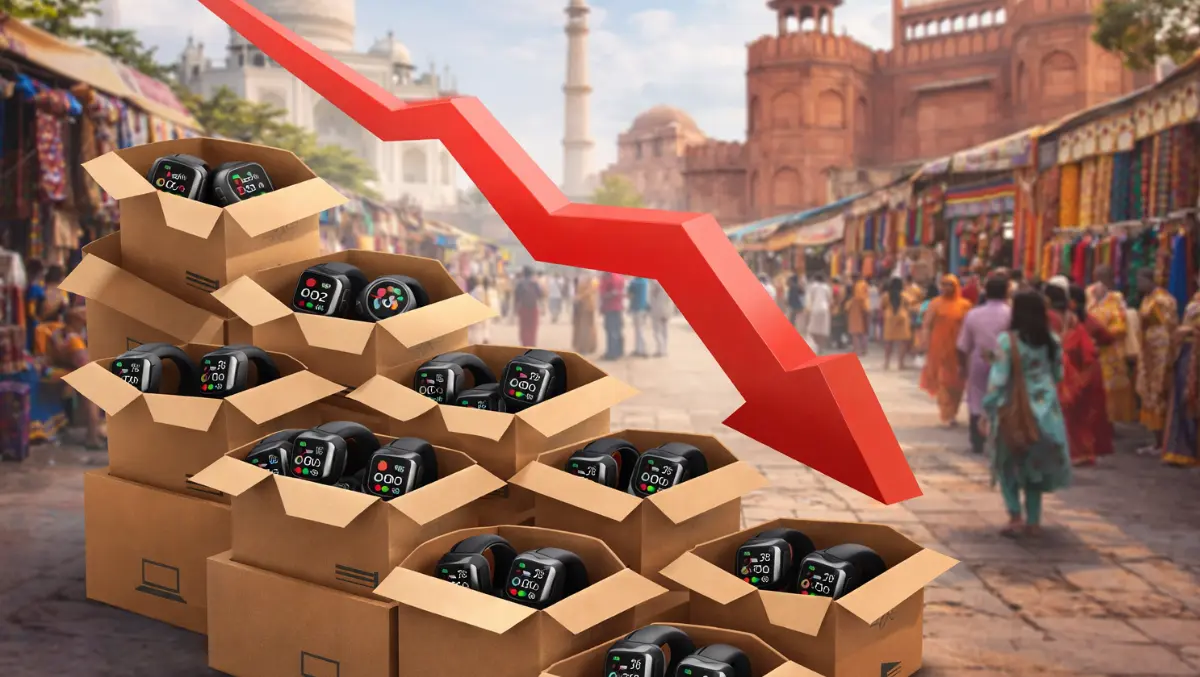
India wearable market falls as smartwatch sales slide
Mon, 2nd Mar 2026
India's wearable device market fell 4.0% in 2025 to 114.2 million units, according to IDC, marking a second consecutive annual decline.
The drop was driven mainly by a 17.6% fall in smartwatch shipments to 28.9 million units. As a result, smartwatches' share of the overall wearables market shrank to 25.3% from 29.4% a year earlier.
Average selling prices across the wearables market still edged up 1.8% to USD $20.3. In smartwatches, the increase was steeper, with average selling prices rising 11.7% year on year to USD $26.5.
Advanced smartwatch shipments fell 8.7% over the year, though the segment's market share edged up to 3.2% from 2.9%. The broader smartwatch category continued to contract even as buyers shifted towards higher-priced devices.
Earwear holds up
Earwear helped support the market, with shipments rising 1.4% to 84.7 million units. Even so, average selling prices fell 1.1% to USD $17.5 as intense mass-market competition and online promotions pressured pricing.
Within earwear, Truly Wireless Stereo products retained the largest share at 70.2%, though volumes were flat, reflecting market maturity and longer replacement cycles.
Neckband shipments fell 10.2%, while over-the-ear headphones posted the strongest growth among earwear product types, rising 65.4% to 7.4 million units. The increase reflected hybrid work patterns and demand for premium audio products.
Brand rankings
boAt increased its share of the overall wearables market to 29.2% from 27.6%, extending its lead. It also led the TWS, tethered and over-the-ear categories, accounting for nearly one-third of total shipments.
In TWS, smartphone-linked brands gained further ground. Nothing, including CMF, posted 91.5% year-on-year growth, while OPPO, including OnePlus, grew 38.2%.
The over-the-ear segment was led by boAt, Samsung's JBL brand and Zebronics. GoBoult and Noise posted year-on-year growth of 698.3% and 276.5%, respectively.
In smartwatches, Noise ranked first with a 26.6% market share. boAt was second with 14.1%, while Fire-Boltt moved into third place with 9.7%. GoBoult remained fifth and reported 29.8% growth.
Shift offline
Offline sales channels strengthened during the year, growing 3.1% and increasing their market share to 40.7% from 37.8%. Online channels declined 8.4%.
The decline online was driven largely by a 22.7% drop in smartwatch shipments, while online earwear fell 3.2%. By contrast, offline earwear grew 9.4%, although offline smartwatch shipments also declined, down 10.5%.
The figures point to a gradual shift towards offline retail. They also suggest brands are relying more on physical stores as online smartwatch sales slow.
New categories
Other wearable categories remained small but showed mixed performance. Smart glasses recorded the fastest growth, with shipments surging 1,541.3% over the year.
Lenskart led the smart glasses segment with a 36.2% share, followed by Meta with 28.4% and Fire-Boltt with 17.1%. Average selling prices for smart glasses rose 152.4% to USD $112.6.
Smart wristbands also recovered, with shipments rising 67.0% to 0.3 million units. Samsung held a 59.0% share, while Pebble ranked second with 14.2%.
Smart rings moved in the opposite direction, with shipments falling 30.6%. Ultrahuman led the category with a 30.4% share, followed by Gabit at 18.3%, while average selling prices slipped 8.7% to USD $159.7.
Market outlook
IDC expects the smartwatch market to remain under pressure in 2026, with shipments likely to decline by a mid-single-digit percentage as brands focus more on higher-value products. Earwear growth is also expected to remain in the low single digits as the category matures.
"Smartwatches are evolving beyond basic tracking. AI-led analytics, advanced sensors, and seamless connectivity are enabling predictive health insights, positioning them as proactive digital wellness partners," said Anand Priya Singh, Market Analyst, Smart Wearable Devices, IDC India.
On earwear, IDC cited pricing pressure and brand differentiation as key themes. "In a highly competitive pricing environment, brands are intensifying differentiation to support higher ASPs through ergonomic open-ear designs and partnerships with established audio specialists for premium sound. As the market stabilizes, strengthening offline reach and protecting brand credibility will be critical, especially amid increasingly sophisticated counterfeits in physical retail," said Vikas Sharma, Senior Market Analyst, Smart Wearable Devices, IDC India.