

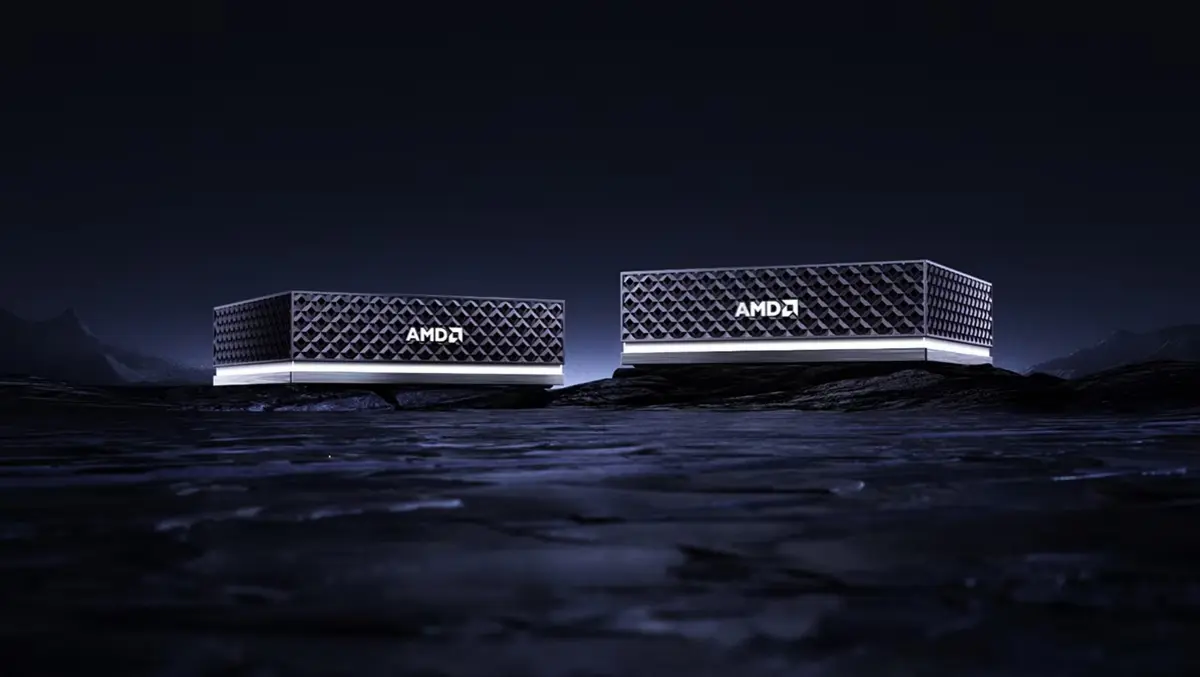

AMD has launched its Ryzen AI Halo developer platform and unveiled Ryzen AI Max PRO 400 Series processors, aimed at the next wave of so-called Agent Computers.
The push centres on running larger artificial intelligence models on local machines rather than relying on remote infrastructure. AMD says the Ryzen AI Halo system can run models of up to 200 billion parameters locally, while the Ryzen AI Max PRO 400 Series is intended for commercial PCs, mobile workstations and small-form-factor desktop systems.
The chipmaker is positioning the products around a shift in AI development toward systems that can build, test and execute software on device. Local execution is becoming more important for real-time tasks, low-latency responses and data handling in enterprise environments, according to AMD.
AMD describes Ryzen AI Halo as its first compact AI developer platform. It is built around Ryzen AI Max+ 395 processors and includes up to 128GB of unified system memory.
That memory allocation is intended to give developers enough headroom to work with large language models and other AI tools that would often run in the cloud. The platform supports both Windows and Linux workflows, letting developers move from Linux-based prototyping and tuning to Windows deployment on the same machine.
AMD says the platform works with widely used tools and frameworks including PyTorch, vLLM, llama.cpp, Ollama, ComfyUI and LM Studio. It adds that the system is optimised for its ROCm software and can be used for large language models, diffusion models and agent workflows on a single device.
Pre-orders for the Ryzen AI Halo platform are due to begin in June 2026 through Micro Centre. A next-generation version of the developer platform is also planned for the third quarter of 2026, using Ryzen AI Max PRO 400 Series processors with higher clock speeds, up to 192GB of unified memory and 160GB of VRAM.
Commercial systems
The Ryzen AI Max PRO 400 Series extends the same architecture into commercial hardware for enterprise deployment. AMD says the processors combine central processing, graphics and AI processing in one design, with RDNA 3.5 graphics, an XDNA 2 neural processing unit, 192GB of system memory and 160GB of VRAM.
The processors are designed for AI developers, engineers and creators working across simulation, content creation and data-heavy workloads. The aim is to reduce dependence on discrete graphics processors or cloud compute by consolidating AI, visualisation and compute functions into a single system.
AMD also says the new processors are the first x86 client chips capable of running 300 billion-parameter models locally. That places the launch in a growing competition among chipmakers seeking to move more AI workloads onto client devices and enterprise PCs.
Jack Huynh outlined AMD's view of that market shift.
"AI is no longer confined to the cloud. It is now something developers can build, train, and run locally," said Jack Huynh, SVP and GM, Computing and Graphics Group, AMD. "With the Ryzen AI Halo and Ryzen AI Max PRO 400 Series, we are delivering the performance, memory, and open AI software stack that developers and enterprises need to bring the next generation of agentic AI systems to life right on their desks."
OEM backing
Leading hardware partners are expected to bring the new processor family into their own systems. HP and Lenovo were named among the manufacturers expected to offer machines using the Ryzen AI Max PRO 400 Series in the third quarter of 2026.
Support from major PC makers will be important if AMD is to turn the launch into broader adoption across commercial fleets and workstation markets. Additional Ryzen AI Halo developer platforms based on the PRO 400 Series are also expected from original equipment manufacturers.
HP linked the launch to demand for systems that can manage more intensive AI workloads locally.
"AI developers and creators need systems that can keep pace with increasingly demanding workflows without complexity," said Ketan Patel, President, Personal Systems at HP Inc. "HP is designing solutions that combine powerful performance, advanced AI capabilities, and the flexibility needed to accelerate from experimentation to production locally, while also ensuring information remains secure. HP is excited to expand our portfolio with the AMD Ryzen AI Halo Platform and Ryzen AI Max PRO 400 Series processors, bringing customers a comprehensive portfolio to support the next generation of agentic AI-driven workflows."
Lenovo also pointed to a broader shift of AI processing from cloud environments to devices used at the edge of work.
"AI is moving from the cloud to where work actually happens: on the device, in real time. Beyond adding new features, it's enabling systems that can execute, adapt and respond instantly, while keeping data local and more secure. With platforms like AMD's Ryzen AI Max PRO 400 Series, we're scaling this through an ecosystem approach by bringing hardware and AI software together to power the next generation of enterprise AI PCs and workstations," said Luca Rossi, President, Intelligent Devices Group, Lenovo.